For the past few months I have become obsessed with the notion of purchasing a motorbike – a lightweight dual-sport – to ride for my daily commute across the East Bay hills. Avoiding the freeway, this route passes through some of the most gorgeous canyons in the area, along snaking roads with spectacular views over the hills and reservoirs. Because California is dry for most of the year, and because of the low speeds and sparse traffic, I reasoned that this route would be considerably safer than the average motorbike trip, within the bounds of acceptable risk I am willing to expose myself to. I also expect that I am very out-of-distribution for ‘people who decide to ride a motorbike’, because I am a cautious person by nature, a conservative driver with decades of cycling experience, and I have excellent balance skills; for example, I used to slackline, ride a mountain-unicycle, and spin around inside a metal hoop (aka: a cyr wheel).
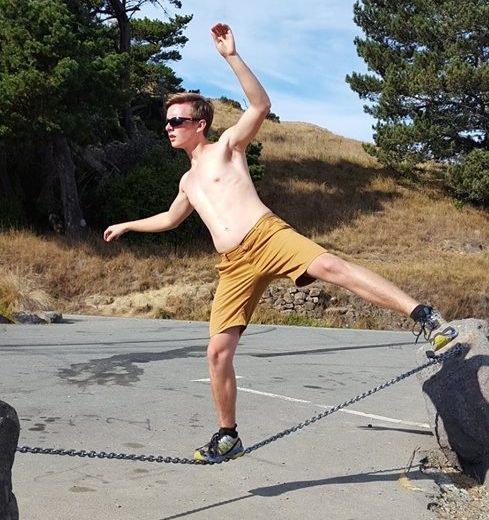
I also have an insatiable desire for adventure. From talking to several friends with decades of cumulative experience riding motorbikes, it seems to be a self-recommending sport, really some of the most fun you can have on a regular basis (assuming good weather conditions). So the tradeoff seemed worth it.
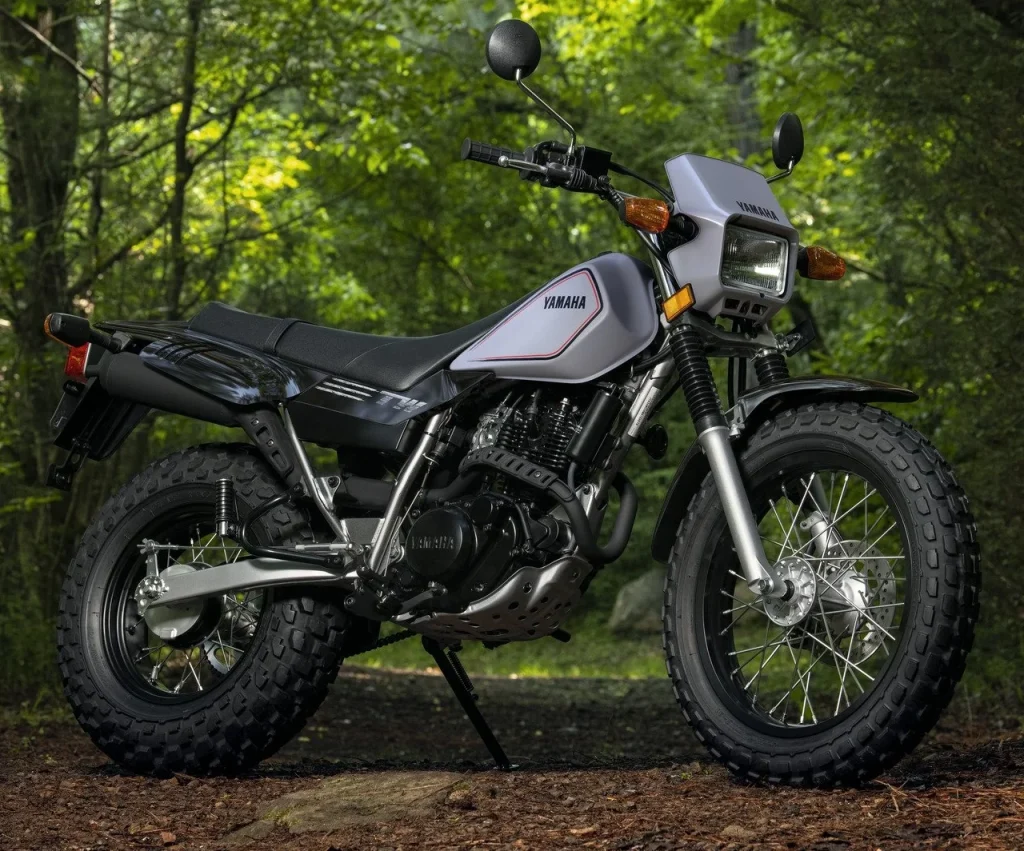
Initially I had settled on the Yamaha TW200, a true workhorse of a bike. I have no interest in going faster than 60mph on this route, nor do I have an interest in using the bike for anything other than this route, and the low seat height was reassuring for stopping at intersections or navigating off-road terrain. Just look at this beautiful machine:
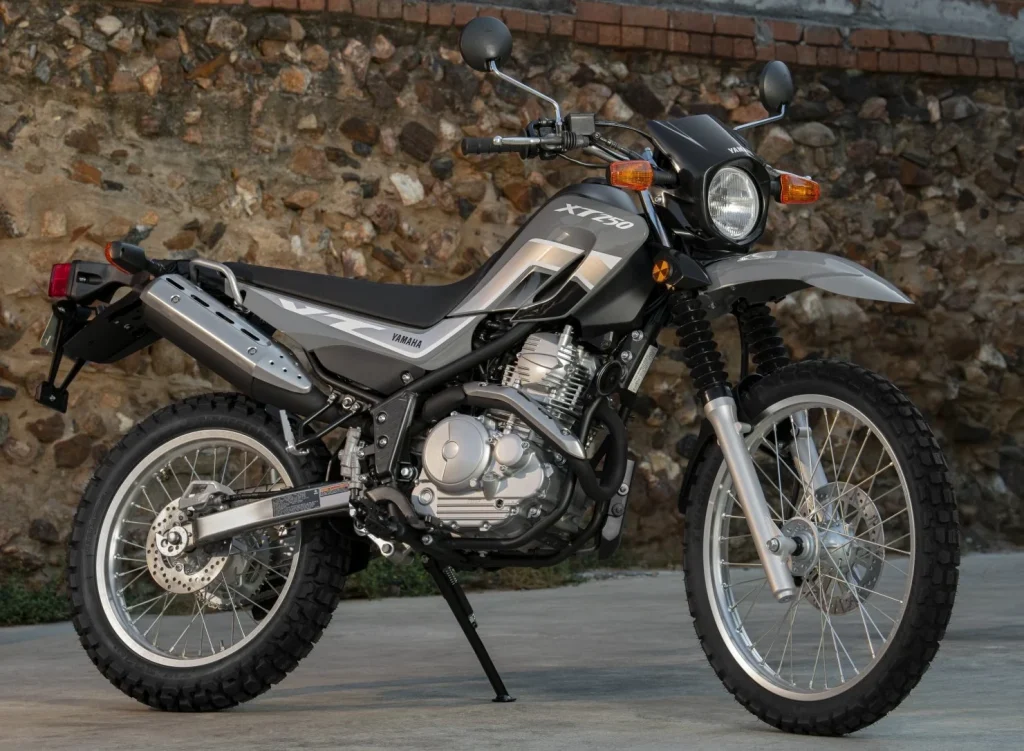
However, after talking to an experienced rider, I became convinced that the Yamaha XT 250 was more suited to this canyon-road commute due to its larger engine and more conventional tires. Again, please bask in the glory of this gorgeous bike:
Aesthetics aside, my partner wasn’t very impressed by my decision, while her sister and mother were even less impressed, due to the perceived risk. So I agreed to make them a powerpoint presentation showing why this specific route, within the constraints I had imposed for myself, would actually not be that unsafe compared to risks we already accept associated with other activities. I made two chats with Opus 5.5 and Sol 6.1 where I built custom risk models for this planned commute, and was surprised to find that the accumulated micromorts (i.e., one-in-a-million chances of dying) from a return trip ranged from 3-10! Here is the output of my risk model, assuming that the micromort discounting rate applies equally to nationwide motorbike injury risk:
- Annual risk of death: 0.078%–0.260% (about 1 in 1,280 to 1 in 385), based on 260 round trips per year at a modeled 3–10 micromorts per trip. NHTSA data used as the model baseline
- Annual risk of nonfatal incapacitating injury: 0.33%–1.09% (about 1 in 305 to 1 in 92), assuming the same proportional risk reduction as for death. Injury-to-death ratio, Table 2.3
While this would be difficult to justify, I thought it was still a reasonable trade-off given how much enjoyment I expected to get out of the commute. Reaction speed also decreases with age (as a function of longer sensory processing and motor preparation), and I’m not getting any younger. So I continued my search, eventually finding two promising motorbikes and making tentative plans to view them.
A few days ago I mentioned these plans to my friend Curran and his response was utter shock and bewilderment, which only increased when he realised that I already understood the risks associated with making this a daily commute. Curran is an experienced investor, so upon sending him my model’s workings, he costed it:
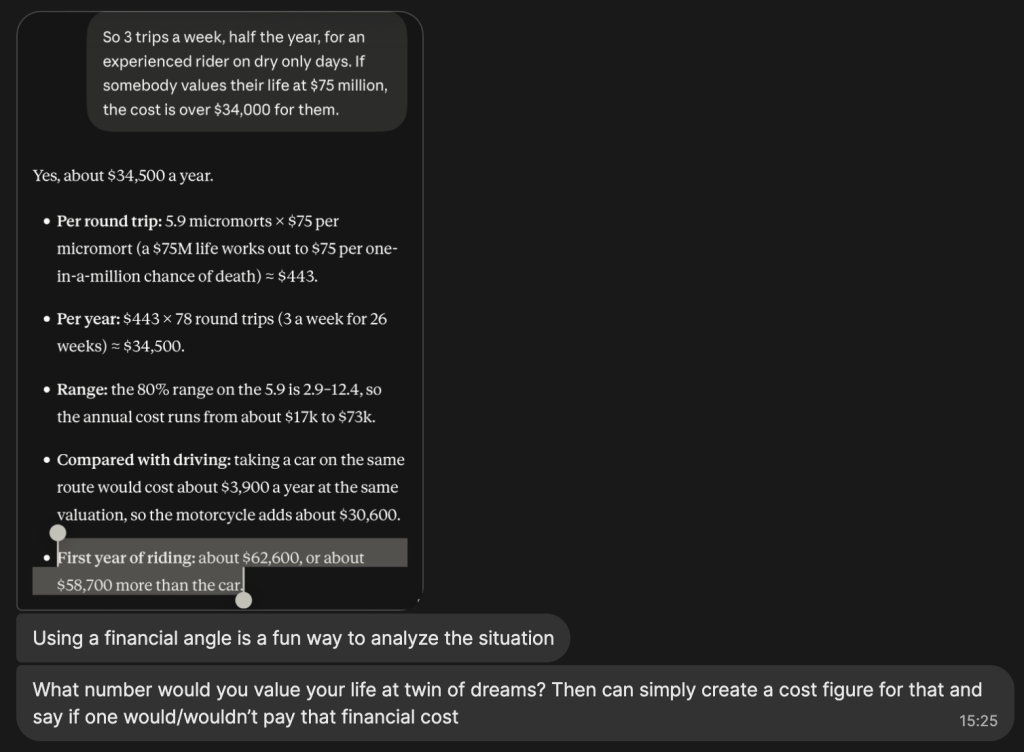
It turns out that the appropriate method to make me update on my biases is to cost them! Because I really don’t like spending money on transient goods.1 To his credit, Curran values my life much more than I do – I would happily accept the US DOT 14.2M valuation, but even so, the risk-adjusted cost per round-trip comes to $152, which is $142 more than I would pay for a comparable experience. Moreover, when you compare the accumulated micromorts to other activities – one round trip is approximately equal to six scuba dives, five and a half marathons, or two and a half skydives – the hedonic calculus clearly favours not riding a motorbike.
And so I decided that I will not purchase a motorbike for my canyon commute. Instead I will begin my search for either a mechanically simple small car (e.g., Honda fit, my favourite model) or a Tesla (because the self-driving feature is superior to most human drivers). I find it interesting how much more sensitive I was to pricing my decisions versus considering different options abstractly, and will be applying this method to evaluate the reasonableness of my life decisions in other domains. Below is the costed risk model for you to play around with.
Canyon Commute Risk Pricer
The cost of one ride and one year of riding, from a value placed on a life and a death risk in micromorts (one-in-a-million chances of dying).
Every scenario at every life value
Tap a cell, row or column to load it above.
The same risk, spent elsewhere
Your micromorts converted into things people already call dangerous.
Log scale; the dashed line marks one. Phase 1 is a ceiling: no drug-caused deaths in about 38,000 healthy volunteers, so the true count is higher.
How the scenarios are built
Rider rows start from about 27 rider deaths per 100 million motorcycle miles (NHTSA 2024 deaths, excluding passengers, over FHWA motorcycle mileage). The route is weighted at 1.7× an average US road (80% range 0.9–3.1), from 2016–2026 California crash records for its canyon roads. A careful rider (sober, licensed, helmeted, at or under the limit) is 0.45× average; dry daylight at 20–30 mph is a further 0.64×; the first year of riding is 1.8×, from insurance claim curves. Serious injuries run about 5.4 per death (California, 2022–2024). Background risk is the SSA 2023 life-table average for 30-year-old men and women, about 1 in 680 a year.
The Tesla row is an estimate, not a measured death rate. It divides the careful-car figure by 3, Tesla’s reported gap in major collisions between FSD (Supervised) and Teslas driven manually; its 9× gap against the US average would put it near 0.07. The data is Tesla’s own, counts collisions rather than deaths, and comes mostly from easier roads where drivers choose to engage FSD.
Sources
- NHTSA motorcycle data, 2024 · CHP crash records · HLDI new riders
- US DOT value of a life · SSA life table
- USPA skydiving · BASE (Lauterbrunnen) · Everest 2007–2024
- Marathons · Scuba · Logging (BLS 2024)
- Phase 1 review · Pfizer phase 1 study · Anaesthesia (Bainbridge 2012)
- Kidney donors (JAMA 2024) · US maternal deaths 2024
- Tesla FSD (Supervised) collision data, 2026
- Ask any of my close friends; while I will happily spend 1k+ on esoteric objects that hold their value, I flinch at the prospect of buying take-outs (except when I am with friends, where I reason that I am paying the maintenance fee of a healthy social relationship). ↩︎
Want email updates for new posts?